
Dental fillings are meant to restore teeth after cavities, fractures, or small areas of damage. They can last for many years, but they are not permanent. Like tires, eyeglass lenses, or orthopedic joints, fillings experience daily wear, and their condition matters more than their age alone.
If you have an older filling and wonder whether it should be replaced, the best answer depends on what your dentist sees clinically and on X-rays. Some old fillings remain healthy and functional for decades, while others quietly develop cracks, leakage, or decay around the edges.
What a Filling Is Designed to Do Over Time
A filling replaces tooth structure that was lost to decay or damage. Its job is to seal the tooth, restore chewing function, protect the inner dentin from bacteria, and maintain the tooth’s shape so your bite remains stable. When a filling is placed well and cared for properly, it can serve that role for a long time.
However, a filling lives in a challenging environment. It is exposed to chewing force, temperature changes, saliva, acidic foods, sticky snacks, tooth grinding, and millions of bacterial organisms. Even excellent dental materials can slowly change. Edges may wear down, tiny gaps may form, and the surrounding tooth can weaken or crack.
The most important point for patients is that age is only one clue. A 20-year-old filling that is smooth, sealed, and supported by healthy tooth structure may not need replacement. A 3-year-old filling with decay underneath or a broken edge may need attention right away. Dentists evaluate function, seal, symptoms, tooth structure, and risk factors before recommending treatment.
How Long Different Types of Fillings Usually Last
Filling longevity varies by material, tooth location, bite force, oral hygiene, diet, and the size of the restoration. Small fillings generally last longer than large fillings because more natural tooth structure remains to support them. Fillings on back teeth often endure heavier pressure than fillings on front teeth.
Composite resin fillings, which are tooth-colored, commonly last several years and may last much longer with excellent care. They bond to the tooth and look natural, which makes them popular for visible areas. Over time, composite can stain, chip, or wear, especially in people who grind their teeth or frequently consume acidic beverages.
Amalgam fillings, often called silver fillings, have a long history of use and can be very durable in molars. The FDA provides patient information about dental amalgam fillings, including material details and considerations for certain groups. Amalgam does not bond to tooth structure in the same way composite does, and older amalgams may be associated with cracks in the surrounding tooth if the restoration is large or the tooth has been under heavy stress for years.
Gold restorations and ceramic inlays or onlays can last a very long time when they are carefully made and maintained. These restorations are often used when a tooth needs more strength than a traditional filling can provide. They are more involved than direct fillings, but they may be a better long-term option for larger areas of damage.
Signs an Old Filling May Need Attention
Some filling problems are obvious. You may notice a sharp edge, a piece that has chipped away, food getting trapped, or a visible crack. You might feel that your bite has changed or that floss shreds when you pass it between certain teeth. These changes can indicate that the filling no longer fits the tooth properly.
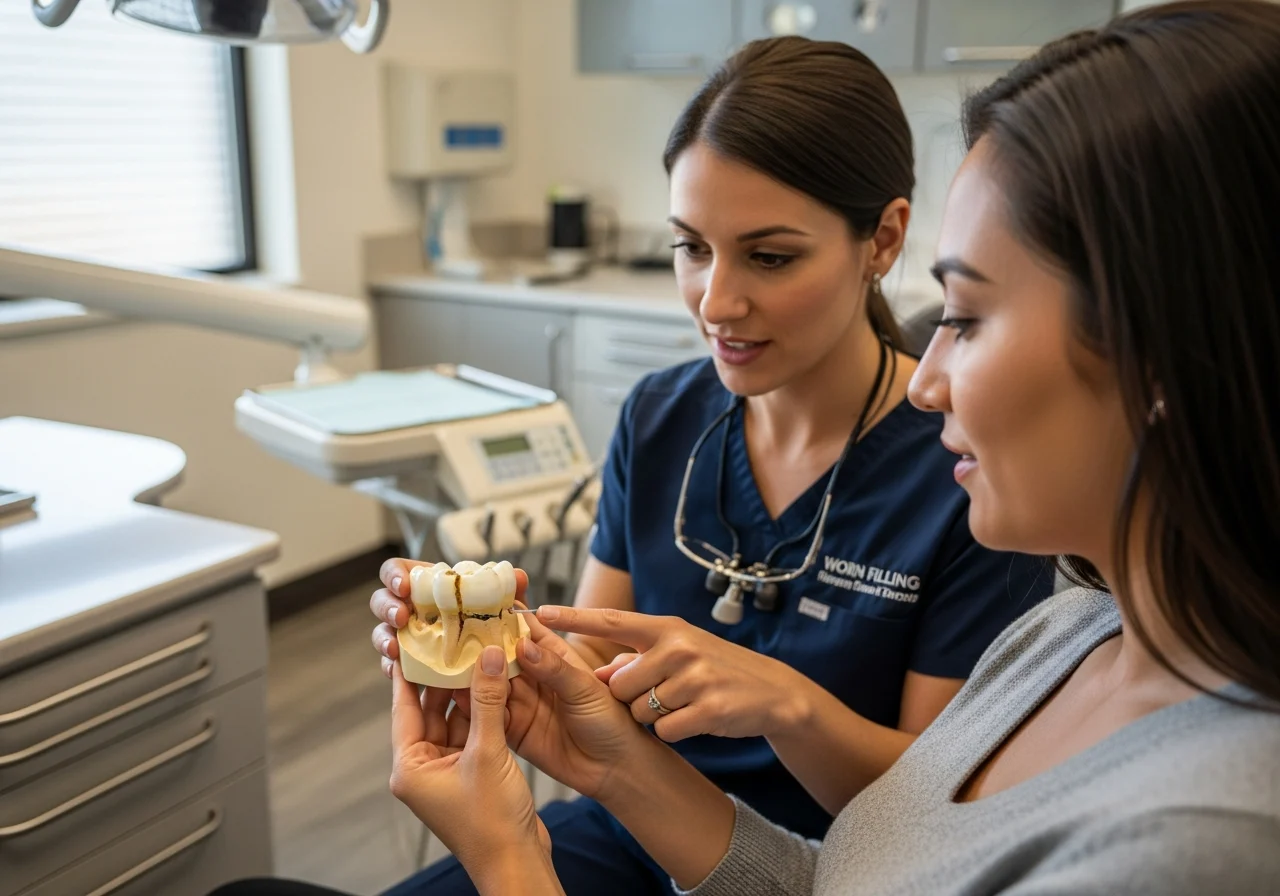
Sensitivity is another common warning sign. A tooth with an aging filling may feel sensitive to cold, sweets, pressure, or chewing. Sensitivity does not always mean the filling must be replaced, but it should be evaluated. Sometimes the cause is gum recession, enamel wear, grinding, or a high bite. Other times, the filling is leaking or decay has returned around it.
Pain when biting can be especially important. It may suggest a cracked filling, a cracked tooth, inflammation inside the tooth, or a restoration that is no longer distributing pressure evenly. If biting pain is sharp and repeatable, avoid chewing on that side until a dentist checks it.
Bad taste, persistent bad breath in one area, swelling, or a pimple-like bump on the gum can indicate infection. These signs should never be ignored. A compromised filling can allow bacteria to reach deeper layers of the tooth, and untreated infection can lead to abscess formation or the need for root canal treatment.
Why Dentists Do Not Replace Every Old Filling Automatically
It may seem logical to replace dental work once it reaches a certain age, but dentistry is more conservative than that. Every time a filling is removed, a small amount of additional tooth structure may be lost, even with careful technique. If a filling is still sealed and the tooth is healthy, replacing it “just because it is old” can sometimes do more harm than good.
Modern dental care focuses on preserving natural tooth structure whenever possible. A dentist may recommend monitoring an older filling if it is stable, symptom-free, and easy to clean. This approach is especially appropriate when X-rays do not show decay and the restoration margins look intact during the exam.
Monitoring does not mean ignoring. Your dentist may take photographs, compare X-rays over time, check with an explorer, test the bite, and evaluate whether floss catches at the margins. Small changes can be documented so that treatment is recommended only when the risk of waiting becomes greater than the benefit of preserving the current restoration.
This is why regular dental visits matter. Problems with old fillings often develop gradually, and early detection allows for smaller, simpler repairs. If a filling fails completely before treatment, the tooth may require a larger restoration, crown, root canal, or extraction.
What Happens When a Filling Starts to Leak
“Leaking” does not mean liquid is pouring through the tooth. In dentistry, leakage usually refers to microscopic gaps between the filling and tooth. Bacteria, acids, and debris can enter those gaps. Over time, this may lead to recurrent decay, which is decay that forms around or beneath an existing restoration.
Recurrent decay can be sneaky because it may not hurt at first. Enamel has no nerves, and dentin may tolerate slow changes for a while. By the time pain appears, the cavity may be deeper. The National Institute of Dental and Craniofacial Research explains how tooth decay develops when bacteria use sugars to produce acids that damage tooth structure.

Leakage can occur because the filling material has worn down, the tooth has flexed under biting forces, bonding has deteriorated, or the edges were difficult to seal due to the original cavity size or location. Fillings near the gumline can be more challenging to keep dry and clean, which may increase the risk of margin breakdown.
If leakage is minor and there is no decay, polishing or repairing the edge may be possible in some cases. If decay is present, the old filling usually needs to be removed so the dentist can clean the tooth and place a new restoration. The sooner this is done, the more natural tooth can often be saved.
When Replacement Is Clearly the Better Choice
A filling should usually be replaced when it is loose, broken, cracked, or surrounded by active decay. Replacement is also commonly recommended when the filling no longer supports the tooth, when there is a gap at the margin, or when the tooth has developed cracks that could worsen under chewing pressure.
Large old fillings deserve special attention. When a filling occupies a substantial portion of the tooth, the remaining enamel and dentin may act like thin walls around the restoration. Over time, those walls can fracture. If a dentist sees that a large filling is weakening the tooth, a crown, onlay, or other protective restoration may be recommended instead of another standard filling.
Replacement may also be needed when symptoms suggest pulpal inflammation, meaning irritation of the nerve tissue inside the tooth. Lingering cold sensitivity, spontaneous throbbing, or pain that wakes you at night can indicate a deeper problem. In those cases, simply replacing the filling may not
be enough. Your dentist may recommend additional testing, such as temperature testing or percussion testing, to determine whether the tooth needs a new filling, a crown, root canal therapy, or another treatment plan.
How to Help Older Fillings Last Longer
The best way to extend the life of a filling is to reduce the forces and bacterial activity that cause failure. Brush twice daily with fluoride toothpaste, floss carefully around restored teeth, and limit frequent snacking on sugary or acidic foods. If you clench or grind, a custom night guard may protect both fillings and natural enamel.
Keep regular dental checkups even when nothing hurts. Professional exams can identify tiny defects before they become emergencies. The CDC offers practical guidance on oral health prevention, including habits that lower the risk of cavities and gum disease.
Takeaways
Old fillings do not always need replacement, but they do need evaluation. A healthy, sealed restoration can often stay in place, while a leaking, cracked, painful, or decayed filling should be treated promptly. The goal is not simply to replace dental work. The goal is to protect the tooth for as long as possible.
Need help with Do Old Fillings Need to Be Replaced??